How to Beat Jet Lag: 13 Tips for Long-Haul Flights

✈️ How to Beat Jet Lag on Long-Haul Flights
There are few things more humbling than a long-haul flight.
One minute you’re thriving… the next you’re wide awake at 3 a.m., starving, disoriented, and wondering why your body thinks it’s lunchtime.
Jet lag is one of the most common travel complaints and one of the biggest things that can impact how you experience a destination, especially if you’re only there for a short time.
But here’s the good news: with the right strategy, you can significantly reduce it (and in some cases, avoid it altogether).
And if you’re traveling with us on a Group Galavant or through one of our Private Galavant itineraries, this is exactly the kind of behind-the-scenes guidance we build into your experience, so you arrive feeling ready to soak it all in, not sleep through it.
Let’s get into it. 💁🏻♀️
🧠 What Is Jet Lag (and Why It Happens)
Jet lag is a temporary disruption to your body’s internal clock, also known as your circadian rhythm.
Your body naturally runs on a 24-hour cycle that regulates when you feel awake, when you feel sleepy, when you’re hungry, and even how your hormones function throughout the day.
When you travel across multiple time zones quickly (like on a long-haul flight), your internal clock doesn’t immediately adjust. It’s still operating on your departure city’s schedule, while your destination is asking your body to do something completely different.
That’s why you might feel:
Exhausted in the middle of the day
Wide awake in the middle of the night
Hungry at odd hours
Foggy, sluggish, or slightly unwell
The goal with jet lag isn’t perfection, it’s helping your body adapt as quickly and smoothly as possible.

🌙 BEFORE YOU FLY
TIP #1 Start Adjusting Your Schedule Early
A few days before your trip, begin gently shifting your sleep and wake times toward your destination. Even adjusting by 1–2 hours can make a noticeable difference. Think of this as giving your body a “head start” so it’s not going from zero to chaos the moment you land.
✈️ ON THE PLANE
TIP #2 Switch to Your Destination Time Immediately
The second you board the plane, mentally (and physically) operate on your destination’s time zone. Check the local time and start aligning your behavior accordingly, eat when they eat, sleep when they sleep. It might feel unnatural, but this is one of the fastest ways to start resetting your internal clock.
TIP #3 Hydrate Like It’s Your Job
Cabin air is extremely dry, and dehydration makes jet lag symptoms significantly worse, such as fatigue, headaches, and that overall “blah” feeling. Aim to drink water consistently throughout your flight, not just when you’re thirsty. A refillable bottle is your best friend here.
👉 If you want to go even deeper on this, I break down all of my go-to wellness habits in my guide on staying healthy while traveling.
TIP #4 Limit Alcohol (Strategically 😉)
Alcohol might help you fall asleep faster, but it reduces the quality of your sleep and dehydrates you even more at altitude. If you do indulge, keep it light and earlier in the flight.
TIP #5 Create a Sleep-Friendly Environment
Quality sleep on a plane is less about luck and more about preparation. Invest in a few key items:
The goal is to make your environment feel as close to “bedtime” as possible, even at 35,000 feet.
TIP #6 Use Light to Control Your Energy
Light is one of the most powerful signals for your circadian rhythm. Exposure to light tells your body to stay awake; darkness signals sleep. Use this to your advantage:
Stay in light when you need to be awake
Dim screens and avoid light when it’s time to sleep
It’s a small shift that makes a big impact.
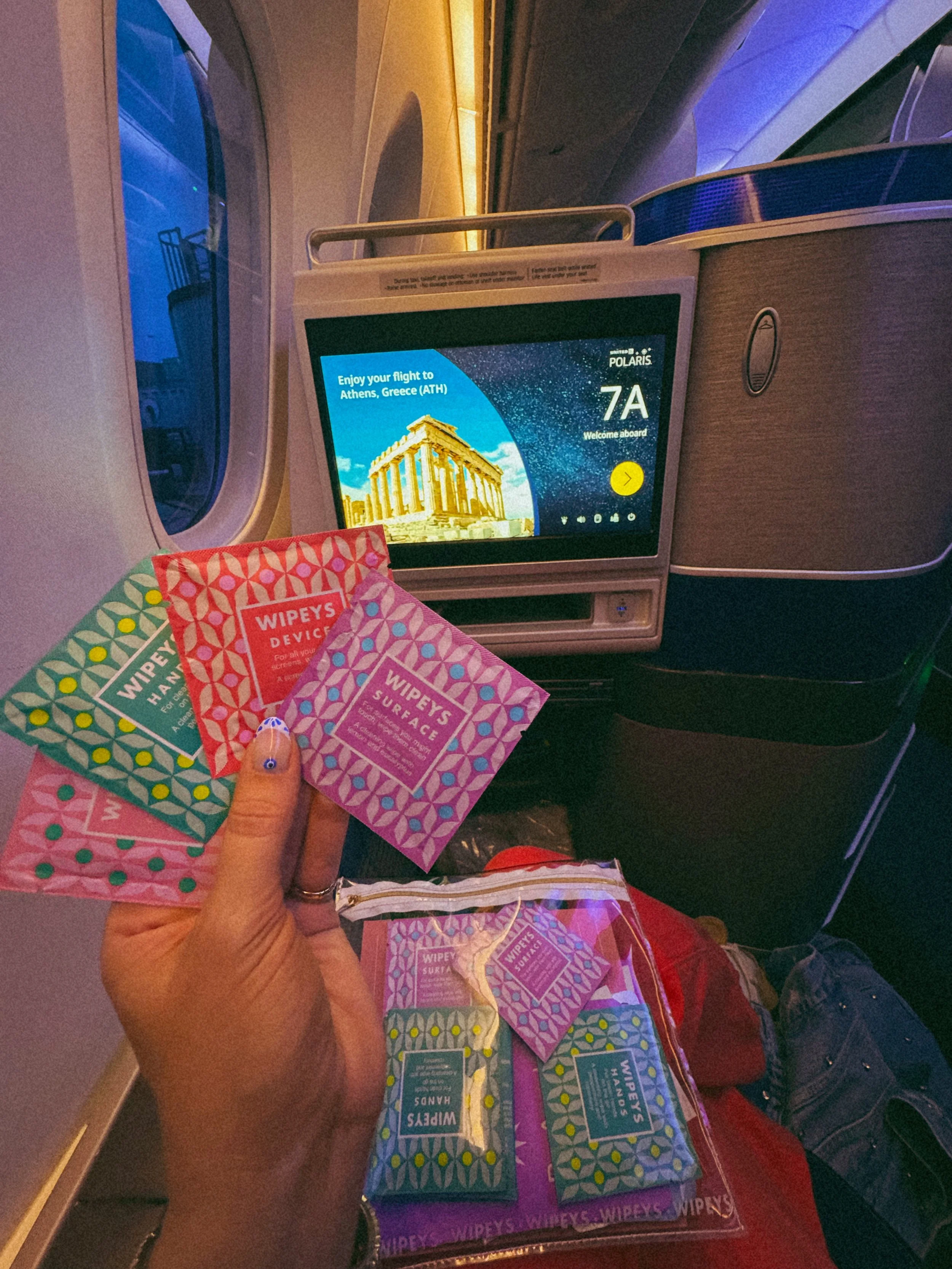
TIP #7 Freshen Up Before Landing
This isn’t just about vanity; it’s about signaling to your brain that a “new day” is starting. Brushing your teeth, washing your face, and changing into fresh clothes can help you feel more alert and ready to transition into your destination.
🌍 WHEN YOU LAND
TIP #8 Do. Not. Nap.
I cannot emphasize this enough.
Napping might feel like the obvious solution, but it will almost always prolong your jet lag. Even a “quick” nap can throw off your ability to fall asleep later, keeping you stuck in that in-between state for days.
TIP #9 Get Outside and Move Immediately
Natural sunlight is the fastest way to reset your internal clock. Pair that with light movement (like walking), and you’re giving your body two powerful signals: we’re awake, and we’re here now. It also helps you mentally orient yourself in a new place, which is a bonus.
TIP #10 Eat on Local Time (Even If You’re Not Hungry)
Your body’s rhythms are tied to more than just sleep; food plays a role, too. Eating meals based on your destination’s schedule helps reinforce the new time zone. Even if it’s something small, it helps your body start to recalibrate.
TIP #11 Take a Cold Shower Reset
After a long-haul flight, your body feels… off. Ending your shower with cold water gives you a quick, effective reset. It boosts circulation, increases alertness, and helps shake off that sluggish, travel-day fog.
TIP #12 Move Your Body (Keep It Simple)
You don’t need a full workout, but some form of movement helps tremendously. This could be:
A long walk
Light stretching
A quick workout
It helps improve circulation, boosts your energy, and signals to your body that it’s time to be awake.
I use both the Peloton app & Melissa Wood Health when I travel - I find MWH a little easier to do on the go because it doesn’t require much space or too much equipment.
TIP #13 Stay Up Until a Normal Bedtime
The first day is the hardest—but also the most important. Push through until a reasonable bedtime (ideally 8–9 p.m. local time). Once you get a full night of sleep aligned with your destination, everything starts to click into place.
💡 BONUS: Use the Timeshifter App
If you want a more personalized, science-backed approach to jet lag, I cannot recommend Timeshifter enough.
I’ve been using it for years, and it’s hands-down one of the most effective tools I’ve found for adjusting to new time zones quickly and actually feeling like a functioning human when you land.
Timeshifter creates a fully personalized plan based on:
Your exact flight details
Departure and arrival time zones
Your typical sleep habits
It then tells you exactly when to:
Sleep
Seek or avoid light
Adjust caffeine
Shift your schedule leading up to and during your trip
It takes all the guesswork out of jet lag and it’s completely backed by science (even astronauts use it, which feels like a pretty strong endorsement).
✨ Galavant Insider Perk: Every Gal who travels with us on a Group Galavant receives a complimentary one-year Timeshifter subscription, so you’re fully supported not just on your way there, but on every trip you take throughout the year.
💫 Planning a Long-Haul Trip?
Whether you’re dreaming of India, South Africa, or a European summer escape, our team at The Galavant Society can help make your next trip seamless.
✨ Join one of our upcoming Group Galavants and travel with an incredible community of like-minded women
✨ Or let us design a fully customized Private Galavant tailored entirely to you
Because the goal isn’t just to get there, it’s to feel amazing when you do.




✨Final Thoughts:
Jet lag might be inevitable, but suffering through it doesn’t have to be.
These small, intentional choices can completely change how you arrive in a destination—and how much you’re actually able to enjoy your time there.
And if you take one thing away from this entire guide:
👉 Skipping naps will change your life.
You may also like…